.png)
Fiji's 2.6-tonne Cocaine Crisis: the impact of narco-subs

Updated: Feb 16
To my deep regret, recent events dictate I write once again about the distressing invasion of the glorious islands of Fiji and her Pacific island neighbours by the increasingly powerful drug cartels of both the Americas and Asia. If you missed previous posts on the topic, read here of how the low-crime Fiji I knew twenty years ago has transformed to become the Pacific hub for the transit, manufacture and supply of drugs to the Australian and New Zealand markets.
What is a narco-sub?
Narco-subs are ocean-going, semi-submersible or fully submersible vessels, often custom-built by drug cartels to transport huge amounts of illegal drugs across oceans. For decades they've been used to smuggle lethal drugs from South America and Mexico into the USA. The newer vessels are often fully submersible in order to reduce detection by authorities' radar or sonar systems.

The first narco-sub to be found in the western Pacific washed up in Solomon Islands last year, empty of cargo. Within months another two followed. The third, pictured, had been stripped of its engines, but a remaining fuel line was labelled 'Made in Colombia 2024'. It seems that although a narco-sub may cost up to US$1 million to build, the vessels are commonly abandoned after the drugs have been transferred for the next leg of their journey.
Fiji's biggest-ever cocaine bust

In mid-January, Fiji Police swooped on remote Vatia on the north coast of Viti Levu. Fiji's biggest island. They'd been alerted by reports from the Vatia village chief of foreigners being seen at night on a derelict jetty.
This local observation fine-tuned intelligence from the USA's Drug Enforcement Agency (DEA) and specialised police units in Australia and New Zealand who have been working with the Fiji Police to intercept smuggled drugs.

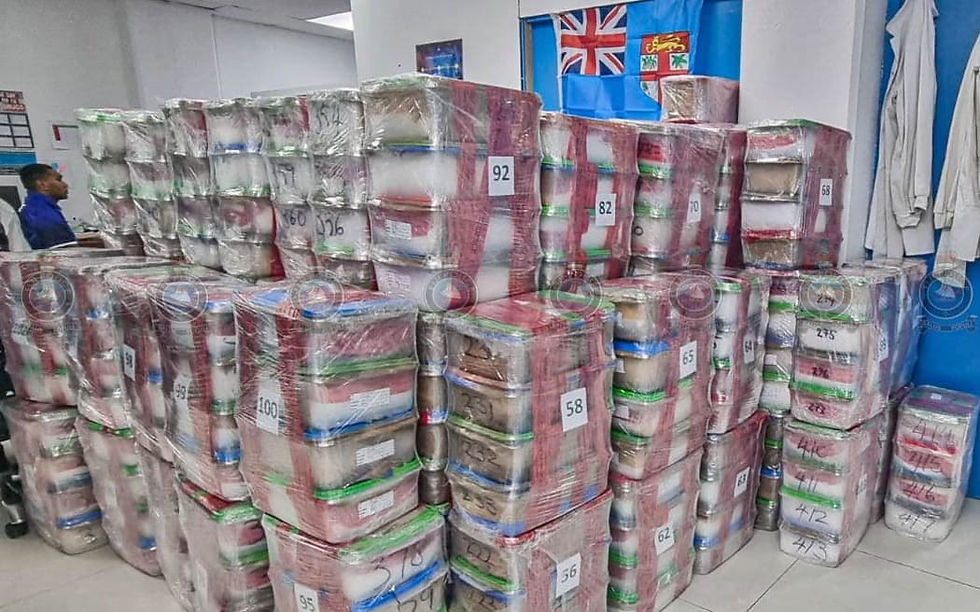
Police arrested six people, including four Ecuadorians, during a raid centring on the long-abandoned Vatia, jetty. The 2.6 tonnes of plastic packages seized contained cocaine, the largest cocaine haul Fiji has seen. The following week, five more arrests were made, and now all 11 accused are now awaiting trial. Sources claim the cocaine was transported on a narco-sub, but the vessel hasn't been found yet.
While a complex investigation continues, commentators hope that Fiji prosecutors' success in the conviction and sentencing of nine methamphetamine smugglers in August 2025 (read more here) will imbue Fiji authorities with the experience and confidence needed to pursue justice in this incredible case.
Experts seem to agree that the arrest of four Ecuadorian nationals could provide valuable intelligence on drug cartel tactics. What's more, this case demonstrates that village chiefs are willing to take on an informal role in reporting local observations to police authorities, something like the role of coast-watchers in World War II. The stakes are just as high.
Naval interceptions in French Polynesia

More than two thousand nautical miles east of Fiji and just the day following the cocaine bust at Vatia, the French Navy conducted a successful operation, intercepting a suspicious vessel in international waters near French Polynesia. The haul was 4.7 tonnes of cocaine which was later dumped at sea and the ship and crew released. The French Navy took the same action following a second seizure later in the week. The President of French Polynesia correctly claimed that his country doesn't have jurisdiction over international waters and, perhaps more dubiously, French Polynesian prisons are already full of drug smugglers awaiting trial.
(See Death Beyond The Limit: Fiji Islands Mysteries 3 for DI Joe Horseman's investigation in international waters.)
International cooperation of Fiji's friends and allies can only help strengthen the tiny nation to resist the tide of poison before the islands become engulfed.
If you have friends interested in Fiji or Pacific islands in general, I encourage you to comment on and share this post.
I look forward to hearing from you!
Bernadette
B.M. Allsopp


Comments